How I evaluate agent handoffs, the part that actually breaks
Here is a failure that taught me where multi-agent systems really break.
A four-agent setup, planner to researcher to critic to writer, passes CI at 0.91 on the final answer. A week later it is at 0.89, and the production trace tells a different story than the score does. The planner dispatched twice when answering inline was right. The researcher dropped two of the constraints it was handed. The critic raised a flag that got buried because the writer never read the return value. And a tool timeout on turn five got swallowed with no retry. Every single agent scored green on its own turn. Every seam between them was broken.
That is the thing I had to internalize. In a multi-agent system, the failures do not live inside the agents. They live in the handoffs between them, and no per-agent score will ever show you that.
Every framework has handoffs, they just call them different things
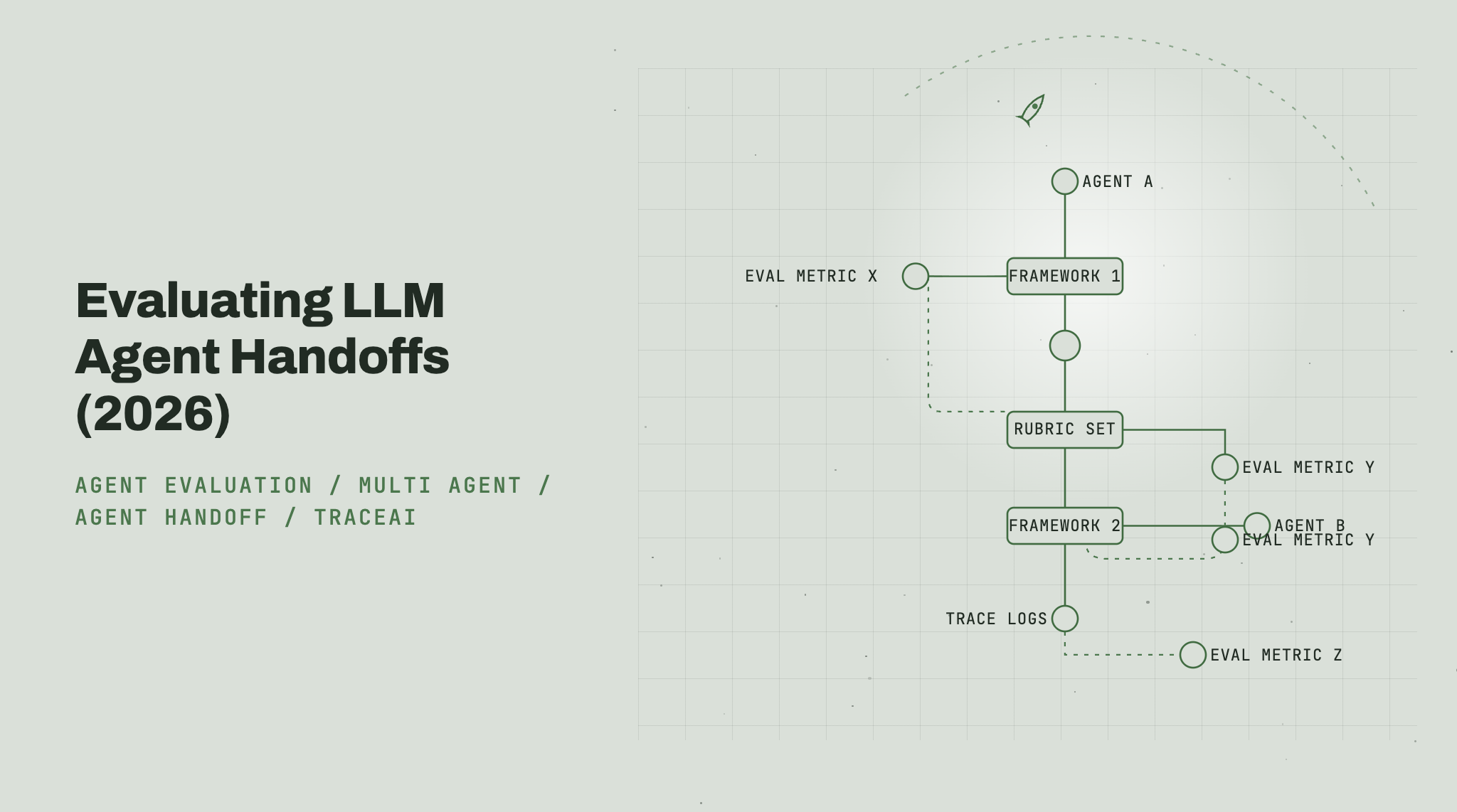
The first realization was that this is one problem wearing a lot of costumes. Every multi-agent framework has the same moment where work crosses from one agent to another, and every one names it differently:
Claude Agent SDK calls it a Task dispatch into a sub-agent.
OpenAI Agents SDK calls it a handoff.
LangGraph models it as an edge between nodes.
CrewAI calls it delegation.
AutoGen treats it as a turn in a group chat.
A2A wraps it as a message between services.
The syntax is different and the shape is identical. A sender produces some output, a scope, and some constraints. A receiver takes them, does the work, and returns a result. The sender reads that result and decides what to do next. Once I saw that, it stopped making sense to write a different evaluation for each framework. The framework picks the syntax. The handoff is the thing I actually score.
Why I score the handoff, not the agents on either side
A single agent is basically a function. Input, prompt, tools, output. Score the output and you are mostly done. A team of agents is not that, because each agent's output becomes the next one's input through whatever narrow channel the framework gives it, and the receiver only ever sees what the sender chose to pass along.
The math is what got me. If every agent scores 0.95 on its own turn, but each handoff quietly drops one constraint, the team can still ship the wrong answer around a third of the time. A team-level number that moves tells you something broke. It does not tell you which seam. The diagnostic only shows up when you score the sender-and-receiver pair itself.
So my working definition of a good handoff has four parts. The sender chose to dispatch, or not, for the right reason. The receiver stayed inside the scope it was given. The sender actually used what came back. And any error on the round trip got handled instead of swallowed. Four failure modes, so I score four things.
Did the sender hand off for the right reason?
The first check is the sender's decision. Was this even the right moment to hand off, or should it have just answered inline? Did it pick the right receiver, or did a research task land on the wrong agent? Was the scope tight, or so vague the receiver had to guess? Did it hand over more tools than the job needed?
One thing I tune here is the asymmetry. When the receiver is expensive, I penalize handing off when it was not needed more than the reverse. When the receiver is cheap and running it inline would blow the latency budget, I flip that. The right bias depends on what the wrong call actually costs.
Did the receiver stay inside the scope it was given?
The second check is the receiver against the scope it was handed. Did it stay inside the brief and the tools it was allowed, or did it wander? Did it call something it was not given? Did it invent context the sender never supplied, the "as we agreed earlier" reference to a turn that never happened? Did the planner start drafting, or the validator start coding?
I score this per receiver type, because a refactor agent drifting into design is a different fix than a research agent drifting into critique. This is also the check that moves first when a model checkpoint gets refreshed. A more eager checkpoint drifts harder, and scope fidelity drops before the final answer quality does, which makes it an early warning worth watching.
Did the sender actually use what came back?
The third check is what the sender does after the receiver returns. Did it read the result, carry the constraints forward, and let it change the plan? Or did it carry on as if the handoff never happened, redo the work inline, ignore a returned constraint, or contradict the receiver with no reason?
I almost missed this one for a long time, because it does not show up as a wrong answer. It shows up as wasted work. The research agent returns something useful, the supervisor ignores it and re-derives the same thing itself, and the user-facing answer looks fine while the cost is doubled. A final-answer score will never flag that.
What happened when the handoff failed?
The last check is the error path. When the receiver fails, times out, or returns an error, what does the sender do? Retry with a tighter scope, fall back, escalate, or just quietly continue with a missing piece? A handoff that fires, fails, and gets ignored is worse than never handing off at all, because now the sender is planning against state that does not exist.
Two rules I hold here. A retry that loops on the exact same scope counts as a failure, not a recovery, unless the error was genuinely transient. And a swallowed error scores zero, always.
How I gate this in CI without one blurry number
The point of splitting these four out is that a failure names itself. I set a threshold per axis and per receiver type, never one team-wide average. Something like dispatch at 0.85, scope at 0.90 per receiver, integration at 0.80, recovery at 0.85. When the gate fails, it fails on a specific axis for a specific receiver, so the bisect is one prompt or one rubric, not a whole team run.
I run it on every change that touches a sender prompt, a receiver definition, or the routing logic, and on every model checkpoint bump, since those move dispatch and scope behavior first.
Build the test set from real handoffs, not made-up ones
The test set has to come from real production handoffs. Synthetic ones mislead, because the sender picks its receiver based on real upstream state, and that state is messy in ways a hand-written case never captures. Forty to two hundred handoffs is enough to start. I stratify by sender-receiver pair so each pair has at least eight to ten examples, and I keep a majority of passing cases, roughly two thirds, because a gate needs a green baseline to notice a regression against.
The mistakes that hide handoff failures
A few habits reliably bury the failures I care about:
Scoring only the final answer, which misses every handoff defect that did not quite poison the output.
Using one rubric for both sides of the handoff, when the sender decides and integrates while the receiver executes inside a scope. Those are different jobs and blur into nothing useful together.
Evaluating over a flat chat transcript with no notion of the handoff itself, so the scope and the return value are simply gone.
Treating model checkpoint refreshes as silent. They are not. Dispatch and scope drift first, so pin your versions and re-run the set on every refresh.
The hard part of multi-agent evaluation was never scoring the agents. It is scoring the seams between them, one transition at a time. Once I started grading the handoff as its own unit, the number finally pointed at the thing that broke.
If you want the deeper version, with the span setup and the CI wiring spelled out, the original writeup on the Future AGI blog is where this thinking comes from.
About the author
- I write when an idea won't leave me alone 🧠 Building AI agents and the tools to build AI agents. Love connecting AI with other fields and yapping about all of them. Follow along if that's your kind of thing.
Comments
Join the discussionNo comments yet. Be the first to comment.